
Southeastern Pennsylvania · County seat: Philadelphia
Buying and Selling Crypto in Philadelphia County
Pennsylvania's only county that is also a city, and the densest crypto kiosk market in the Commonwealth by a wide margin.
Our starting point for readers in Pennsylvania is a platform that actually holds the paperwork: a FinCEN-registered Money Services Business with a Pennsylvania Money Transmitter Licence (No. 112703) issued by the Department of Banking and Securities, plus licences across all 50 states and NMLS ID 1804170.
Reviewed & updated August 2026
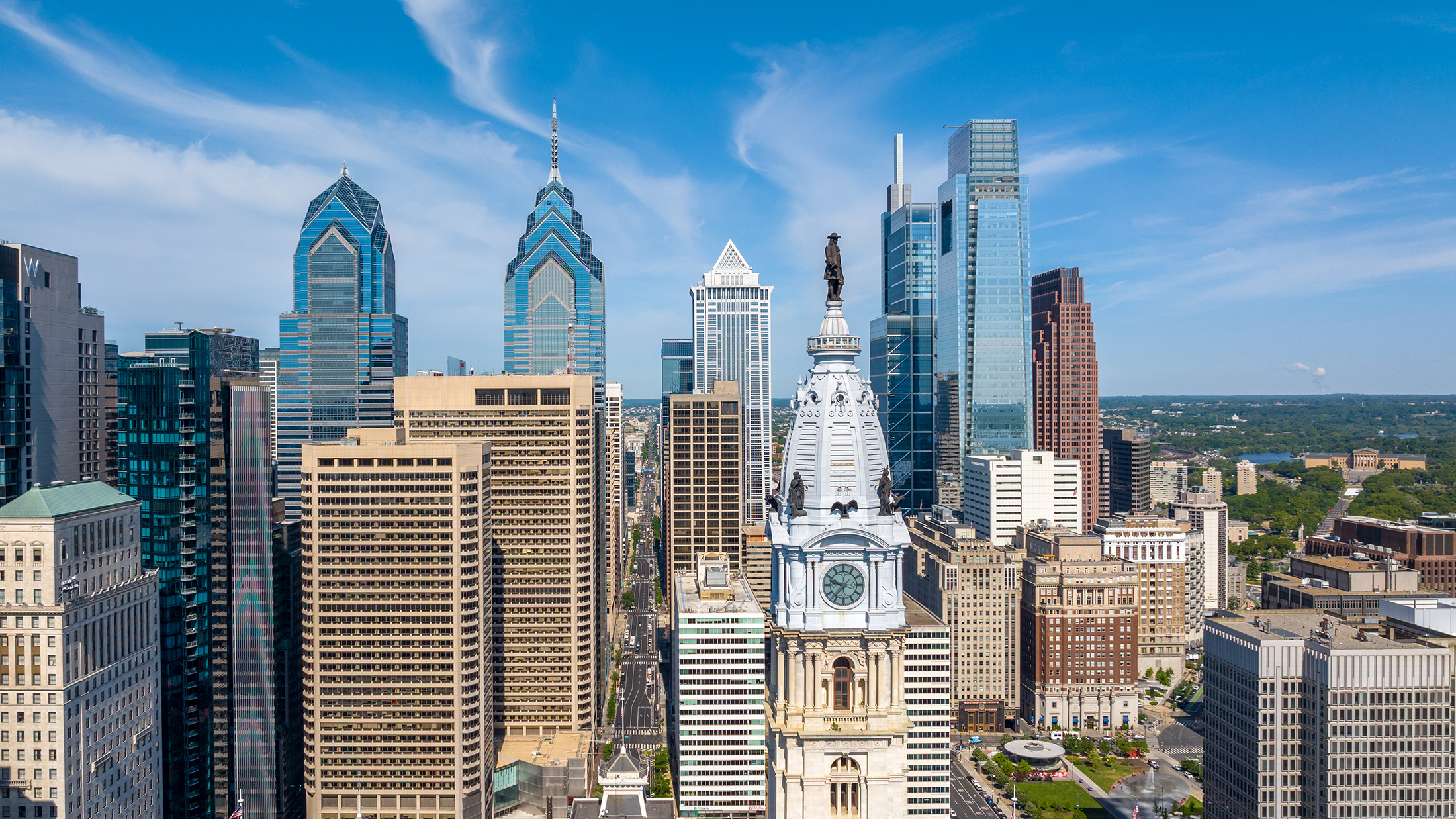
Philadelphia County and the City of Philadelphia are coextensive — one government, one boundary, 1.55 million people. It is Pennsylvania's most populous county by a factor of five and it dominates the state's crypto landscape in every measurable way: most kiosks, most transaction volume, most fraud reports, and the deepest concentration of financial institutions serving crypto customers.
What the county does not have is cheap kiosk pricing. The machines here charge what machines charge everywhere — somewhere between 8% and 23% all-in once the exchange-rate spread is counted — and the density does not create price competition, because nobody comparison-shops a machine they walked past.
- The county's kiosk landscape
- Licensed exchange options for county residents
- Fraud concentration and reporting
- Tax for Philadelphia County residents
- The Center City paradox
- How to buy crypto in Philadelphia County
- Routes and costs compared
- Exchanges serving Philadelphia County
- Towns & municipalities covered
- FAQ
The county's kiosk landscape
Coverage across Philadelphia runs into the hundreds of machines, concentrated in the commercial corridors rather than the office core. Northeast Philadelphia — Roosevelt Boulevard, Cottman, Castor and Frankford Avenues — carries the heaviest cluster. West Philadelphia along Lancaster Avenue and 52nd Street, South Philadelphia along Passyunk and Snyder, and Kensington along Aramingo all have significant coverage.
Center City has fewer machines than visitors expect, because the office district is not a cash economy. Where they exist, they sit in convenience stores around Market East and along Chestnut and Walnut Streets.
Reliability is the persistent issue. A machine listed on any online map may be powered off, out of cash for sell transactions, or inside a business that has closed. Roughly a third of Philadelphia machines are buy-only. Call the host store before travelling. Our Philadelphia bitcoin ATM guide breaks the network down by neighbourhood.
Licensed exchange options for county residents
Every nationally licensed exchange serves Philadelphia County. The practical question is which funding method you use, because that drives your cost far more than the platform choice does.
ACH from a Philadelphia bank — Citizens, PNC, TD, Wells Fargo, Santander, or a credit union such as American Heritage, Police & Fire FCU or TruMark — is free and settles in one to three business days. All-in trading cost is normally under 1%. A debit card is instant at roughly 2–4%. A domestic wire settles same-day for a flat fee and makes sense above about $5,000.
One local note: several Philadelphia credit unions apply a manual fraud review to a first-time crypto-related transfer. A branch call clears it. See our Pennsylvania exchange comparison for the platform-by-platform detail.
The cheaper route for Philadelphia County
A licensed platform holding Pennsylvania Money Transmitter Licence 112703, FinCEN MSB registration and NMLS ID 1804170 — bank funding, published fees, and none of the spread a cash kiosk hides.
Fraud concentration and reporting
Pennsylvania ranked sixth nationally for internet crime complaints in the FBI's 2025 Internet Crime Report, with more than 31,000 complaints and over $537 million in reported losses. Philadelphia County contributes disproportionately to that total simply by population.
The dominant local pattern is kiosk-directed fraud: a caller impersonating PECO, the Philadelphia Parking Authority, the Social Security Administration, a court or a family member, keeping the victim on the line while they feed cash into a machine. Pennsylvania's Bureau of Consumer Protection reported 85% of its crypto complaints came from people aged 60 or over.
Report to the Pennsylvania Attorney General's Bureau of Consumer Protection and to IC3. Full detail in our scam prevention guide.
Tax for Philadelphia County residents
Pennsylvania levies a flat 3.07% personal income tax on net gains from crypto disposals, plus federal capital gains tax. The Philadelphia wage tax applies to compensation, not to investment gains, so a profit on a bitcoin sale is not subject to it.
If you are paid in cryptocurrency for work performed in Philadelphia, that is compensation. It is valued in dollars at receipt and is subject to Philadelphia wage tax as well as state and federal income tax.
Pennsylvania does not permit capital loss carryforward, so realising gains and losses within the same tax year is materially better than splitting them across a year boundary. Our Pennsylvania crypto tax guide covers the detail.
The Center City paradox
Visitors to Philadelphia consistently expect to find crypto kiosks downtown and consistently do not. Center City has fewer machines than Frankford Avenue, despite carrying vastly more daytime population and considerably more money.
The reason is that a kiosk needs cash-in volume, and an office district does not produce it. People working in the towers around Market East pay by card, bank by app, and have no reason to feed banknotes into a machine. The commercial corridors of the Northeast, West and South Philadelphia do produce that volume, which is why the machines are there.
It is worth stating the uncomfortable version plainly: in Philadelphia County, crypto kiosk density correlates inversely with household income. The neighbourhoods paying the highest effective fees are the ones least able to absorb them, and the neighbourhoods that could easily afford a 15% premium have almost no machines at all.
How to buy crypto in Philadelphia County, step by step
The sequence below applies anywhere in Philadelphia County, from Philadelphia out to the smallest township. Nothing about it changes by municipality — Pennsylvania licensing and tax rules are statewide, and every licensed exchange serves every ZIP code in the county on identical terms.
- Choose a platform that holds a Pennsylvania licence
Since 15 October 2024 the Department of Banking and Securities expects businesses transmitting virtual currency for Commonwealth customers to hold a Money Transmitter Licence. Look any company up in NMLS Consumer Access and the FinCEN MSB registrant search before you deposit anything.
- Verify your identity
A PennDOT driver's licence or state ID, your Social Security number or ITIN, a Philadelphia County residential address and a short selfie. Usually cleared in under ten minutes. Non-citizens can generally verify with an ITIN and supporting documents.
- Link a bank account and fund by ACH
Free to move, one to three business days to settle. A first transfer may draw a manual fraud review at a community bank or credit union — that is protective, and a branch call clears it. A small $50 first transfer establishes the pattern and avoids delays later.
- Place a limit order, not an instant buy
The single most expensive habit in retail crypto. The same platform, the same asset and the same minute can cost one to three percent more through the one-click widget than through the order book. Find the advanced or pro tab on day one.
- Move long-term holdings to self-custody
Crypto on an exchange is not FDIC- or SIPC-insured. Once a position is large enough that losing it would change your circumstances, move it to a hardware wallet — see our custody guide.
- Export your transaction history annually
Pennsylvania taxes net gains at a flat 3.07% and does not permit capital loss carryforward, so accurate year-boundary records matter more here than in most states.
Routes and costs for Philadelphia County residents
What separates a cheap purchase from an expensive one in Philadelphia County is the funding method, not the platform. The table below shows what a $500 conversion actually yields on each route, with the exchange-rate spread included rather than hidden.
| Route | All-in cost | You receive | Bank account needed |
|---|---|---|---|
| Licensed exchange, ACH, limit order | ~0.8% | ~$496 | Yes |
| Licensed exchange, debit card | ~3% | ~$485 | Yes |
| Supermarket cash-to-crypto kiosk | ~5–16% | ~$460 | No |
| Standalone crypto ATM | 8–23% | ~$425 | No |
The gap between the top row and the bottom is about $71 on a single $500 purchase. Repeated monthly by a Philadelphia County household, that is over $850 a year for exactly the same asset, held in exactly the same wallet.
Two Pennsylvania-specific points follow the purchase. The Commonwealth taxes net gains at a flat 3.07% with no progressive brackets and no preferential long-term rate, and no Philadelphia County municipality levies income tax on investment gains — local earned income taxes apply to wages only. And Pennsylvania does not permit capital loss carryforward, so if you hold both winners and losers, realising them in the same calendar year rather than across a December–January boundary can meaningfully reduce your state bill. Our tax guide works through the arithmetic.
Exchanges available across Philadelphia County
Platform availability does not vary by Pennsylvania county — every licensed exchange serving the Commonwealth serves Philadelphia County. What varies is which funding method makes sense for you, and that is where most of the cost difference lives.
| Platform | Best for | Typical trading fee | Funding methods | Min buy |
|---|---|---|---|---|
| CEX.IO | Licensed cash-in with full PA coverage | Spot from ~0.25%; card buys higher | Card, ACH, domestic wire, balance | ~$20 |
| Coinbase | First-time buyers who want a name they recognise | Advanced 0.00–0.60%; simple buys higher | ACH, debit card, wire, PayPal, balance | $2 |
| Kraken | Low-cost spot trading and staking | Pro maker ~0.25% / taker ~0.40% | ACH, wire, debit card, balance | ~$10 |
| Gemini | Custody-conscious buyers and estate planning | ActiveTrader ~0.20% / 0.40% | ACH, wire, debit card, balance | $1 |
| Crypto.com | Mobile-first users who also want a spend card | Exchange from ~0.075%; app spread ~0.5%+ | ACH, debit/credit card, wire, balance | ~$1 |
| Bitstamp | Straightforward spot buying with no gimmicks | From ~0.30% / 0.40% | ACH, wire, card, balance | ~$25 |
Fee schedules verified August 2026 and subject to change without notice. Always confirm the live schedule on the operator’s own site before trading.
Before funding any account, verify the operator's licensing yourself in NMLS Consumer Access and the FinCEN MSB registrant search. Both are free and take a minute each. Our Pennsylvania crypto law guide explains what the licence actually means.
Towns and municipalities in Philadelphia County
The guidance on this page applies across the county. These are the larger communities where readers most often ask about local coverage:
- Center City
- Northeast Philadelphia
- West Philadelphia
- South Philadelphia
- Germantown
- Kensington
- Roxborough
- Manayunk
- Fishtown
- Chestnut Hill
Detailed city guides in Philadelphia County
Philadelphia County crypto FAQ
How many bitcoin ATMs are in Philadelphia County?
Coverage across the city runs into the hundreds, concentrated in Northeast Philadelphia, West Philadelphia, South Philadelphia and Kensington. Numbers change as operators rotate locations, and roughly a third of machines are buy-only.
Does Philadelphia wage tax apply to crypto gains?
No. Philadelphia's wage tax applies to compensation, not investment gains. You owe Pennsylvania's flat 3.07% plus federal capital gains tax. If you are paid in crypto for work, that is compensation and wage tax does apply.
What is the cheapest way to buy crypto in Philadelphia?
An ACH-funded limit order on a licensed exchange — under 1% all-in — versus 8–23% at a kiosk. See our Philadelphia city guide for the local detail.
Where do I report crypto fraud in Philadelphia?
The Pennsylvania Attorney General's Bureau of Consumer Protection and the FBI's IC3. Report to local police as well if a loss has occurred, and keep the kiosk receipt, wallet address and caller number.