
Pennsylvania · Cash to crypto
How to Buy Bitcoin with Cash in Pennsylvania
There are five realistic ways to turn physical dollars into bitcoin in Pennsylvania, and the difference between the best and worst is roughly twenty-fold. Here is all of them, priced honestly.
Our starting point for readers in Pennsylvania is a platform that actually holds the paperwork: a FinCEN-registered Money Services Business with a Pennsylvania Money Transmitter Licence (No. 112703) issued by the Department of Banking and Securities, plus licences across all 50 states and NMLS ID 1804170.
Reviewed & updated August 2026
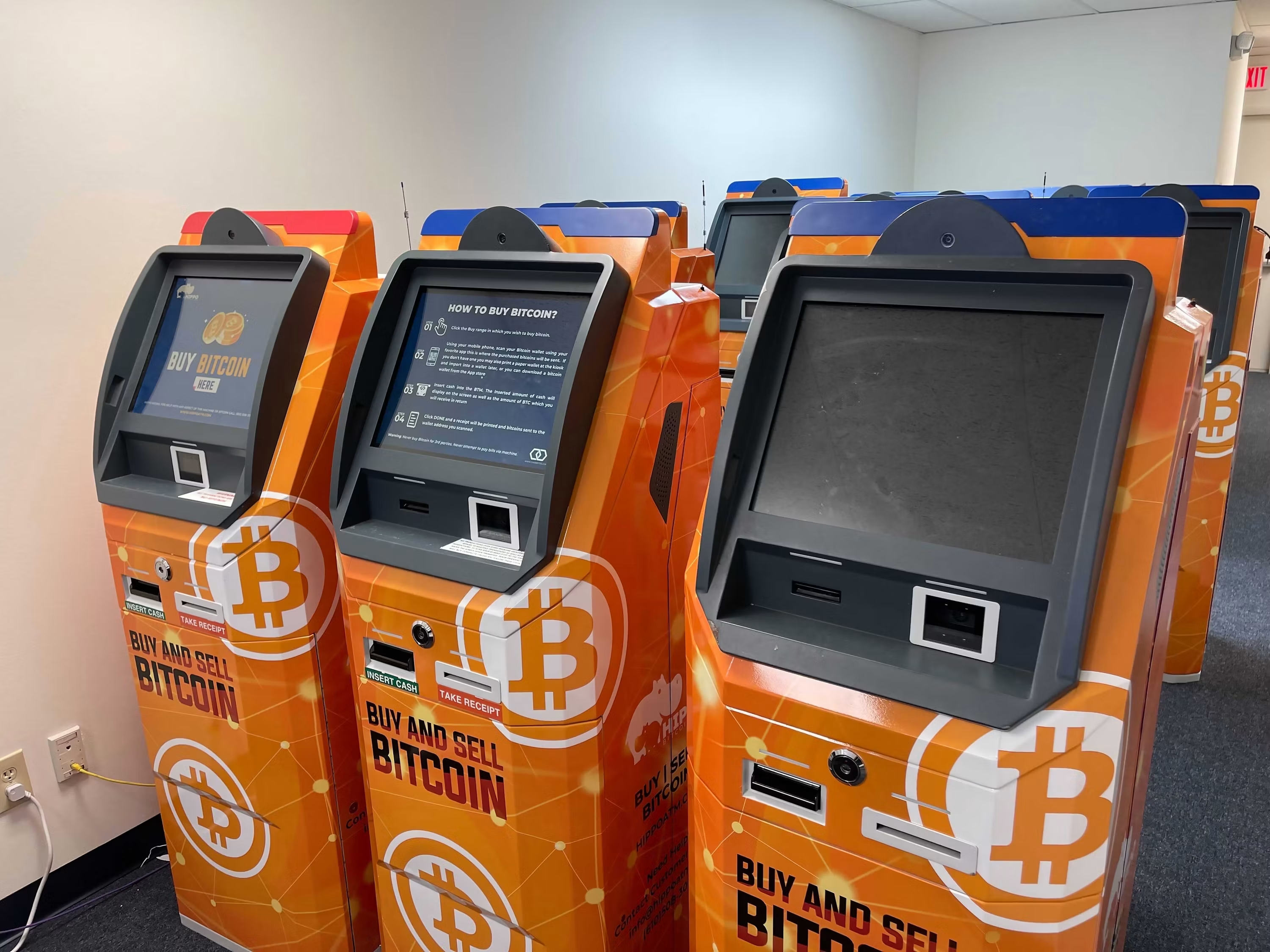
Cash is still how a lot of Pennsylvania works. Weekly-paid warehouse and hospitality jobs, tips, side work, and the significant share of households in cities like Reading, Chester and Upper Darby that operate largely outside the banking system — all of it means physical dollars looking for a door into digital assets.
The crypto industry has built several such doors, and they are priced very differently. The convenient ones cost between eight and twenty-three percent. The cheap one costs under one percent and requires two extra days of patience. Most people take the convenient door because nobody has ever laid the alternatives side by side.
So here they are — all five, with realistic costs, the identity requirements each involves, and honest notes on when each actually makes sense.
The five routes, ranked by cost
| Route | All-in cost | Speed | Bank account needed? |
|---|---|---|---|
| Bank deposit + licensed exchange | Under 1% | 1–3 business days | Yes |
| Debit card on a licensed exchange | ~2–4% | Instant | Yes (or a prepaid card that is accepted) |
| Supermarket cash-to-crypto kiosk | ~5–16% | Minutes | No |
| Cash-load prepaid card or voucher | ~5–12% | Minutes to hours | No |
| Standalone crypto kiosk | 8–23% | Minutes | No |
On a $500 conversion, that spread means receiving roughly $496 at the top of the table and roughly $400 at the bottom. Same cash, same asset, same afternoon.
Route 1 — deposit the cash, buy on a licensed exchange
Unglamorous and by far the cheapest. Deposit your cash at a branch or ATM, wait for it to clear, then transfer by ACH to a licensed exchange and place a limit order. All-in cost typically lands under one percent.
Pennsylvania is well served for this. Every national bank operates here, and the Commonwealth has an unusually deep community banking and credit union sector — PSECU, Members 1st, TruMark, Sun East, Riverfront, Diamond, Cross Valley, American Heritage and dozens more. None of them prohibits transfers to licensed crypto exchanges.
Two practical notes. First, a first-time transfer to a crypto platform may be held for manual fraud review, particularly at community institutions. That is a protection, not an obstruction — a branch call clears it, and making a small $50 first transfer establishes the pattern. Second, cash deposits above $10,000 trigger federal currency transaction reporting. That is a filing requirement your bank handles, not a prohibition, and deliberately structuring deposits to stay below it is a federal offence in its own right. Deposit normally.
The trade-off is time: one to three business days for the ACH to settle. If you can tolerate that, nothing else on this page competes.
Route 2 — supermarket cash-to-crypto kiosks
The coin-counting machines in supermarket lobbies now sell bitcoin at a large number of Pennsylvania locations, through a partnership between the kiosk operator and a crypto provider. Because they run on an existing retail footprint, coverage is far wider than any standalone crypto kiosk network — hundreds of Pennsylvania supermarkets rather than a few hundred machines statewide.
How it works: you create an account with the crypto provider (doing this before you arrive saves real time at the machine), provide a phone number at the kiosk, insert cash, and the machine quotes a total before you confirm. Bitcoin is credited to the provider account, from which you can move it to your own wallet.
Cost is the caveat. Purchases through these kiosks typically combine a transaction fee — around 4% is commonly cited — with a spread charged by the provider, and some locations quote a cash exchange fee that runs well into double digits. In one widely reported configuration, a $100 cash transaction produced roughly $83.50 of bitcoin.
So: cheaper than most standalone crypto kiosks, considerably more expensive than a bank transfer, and much easier to find than either. A reasonable middle option if you have no banking relationship and want something more predictable than a smoke-shop machine.
Route 3 — cash-loaded prepaid cards
Load cash onto a prepaid Visa or Mastercard at a retail counter, then use that card to fund a purchase on a licensed exchange. It works, sometimes, and the arithmetic needs checking each time.
Acceptance is the first hurdle. Many exchanges decline prepaid card BINs outright, and those that accept them may require the card to be registered with your name and billing address. Register the card online before you try — an unregistered prepaid card fails address verification and the transaction declines.
Stacked fees are the second. A retail cash load typically costs a few dollars flat. The exchange's card processing fee is typically 2–4%. On a small load, the combined cost can approach what a kiosk charges, which defeats the purpose. Run both numbers before committing.
Retailer gift cards are a different thing entirely. A store-branded gift card — Amazon, Target, Apple — generally cannot be used to buy crypto directly. Peer-to-peer platforms that claim to convert them are a well-established fraud vector. Our gift card hub covers which card types actually convert and which are traps.
Route 4 — cash vouchers
Cash voucher networks let you pay physical cash at a participating retail counter in exchange for a code, which you then redeem on a supported platform. They are more common in Europe than in the United States, but several operate here and a few Pennsylvania retailers participate.
The appeal is genuine: no bank account, no card, no chargeback exposure for the merchant, and a fixed known cost rather than a hidden spread. The limitation is acceptance — vouchers only work where the receiving platform supports that specific network, and the list is short.
Typical costs run in the mid single digits to low double digits, which places them between supermarket kiosks and standalone crypto ATMs. Our voucher hub covers each network individually — what it costs, where it is accepted, and what to watch for.
Voucher codes are bearer instruments: whoever holds the code holds the value. That makes them a favourite of scammers, who will ask a victim to buy a voucher and read the code over the phone. Once read aloud, it is spent. Never share a voucher code with anyone, for any reason, and never buy one at someone else's instruction.
Route 5 — standalone crypto kiosks
The most visible option and the most expensive. Pennsylvania has several hundred crypto kiosks, heavily concentrated in Philadelphia and its inner suburbs, the Lehigh Valley and Greater Pittsburgh.
All-in cost runs 8–23% once the exchange-rate spread is counted alongside the advertised transaction fee. Large national networks sit toward the lower half; independent single-machine operators regularly exceed 20%.
There is a real use case: instant conversion, cash accepted, no bank account, twenty-four hours a day. If your situation genuinely calls for that, kiosks are a legitimate tool. Two habits reduce the damage. First, insert the smallest note the machine accepts and read the quoted rate before committing the rest — every compliant machine allows cancellation before confirmation. Second, larger single transactions are proportionally cheaper than several small ones, because flat fees do not scale.
Our bitcoin ATM guide covers how the machines work, and the fee comparison breaks down what each operator charges.
If you have a bank account, you are already on the cheap route
An ACH-funded purchase on a platform holding Pennsylvania Money Transmitter Licence 112703, FinCEN MSB registration and NMLS ID 1804170 typically costs under 1% all-in. Verification takes under ten minutes with a PennDOT ID.
If you genuinely have no bank account
We are aware that "just open a bank account" is easy advice to give and harder to act on. Past overdraft records, ChexSystems entries, distrust built on real experience with fees and closures — these are legitimate reasons, not excuses.
Two things are worth knowing anyway. First, Pennsylvania's credit union sector is deep and much of it is explicitly community-oriented. Institutions across Philadelphia, Delaware County, Berks, Luzerne and Allegheny counties offer low-minimum accounts, and several offer second-chance products designed for people the banking system has previously turned away. Membership is usually geographic or employer-based.
Second, if that route is closed to you today, the order of preference among the remaining options is: supermarket cash-to-crypto kiosk, then a registered prepaid card if the combined fees work out, then a voucher network if your platform supports one, then a standalone crypto kiosk. Within that last category, a large national operator will almost always beat an unbranded independent machine.
And in every case: read the quote before you commit, and walk away from anything that will not show you a rate.
ID requirements and the anonymity question
Every legitimate cash-to-crypto route in the United States involves identity verification, because every operator is a money services business subject to the Bank Secrecy Act. The requirements escalate with the amount.
- Smallest kiosk transactions — name, date of birth and a mobile number verified by SMS.
- Mid-range purchases — a government photo ID scan plus a live selfie matched against it. A PennDOT driver's licence or state ID works well.
- Larger transactions — Social Security number collection and enhanced screening, often with manual pre-approval through the operator's support team.
- Licensed exchanges — full verification up front: photo ID, SSN or ITIN, US residential address, and a selfie.
Several major kiosk operators have moved to requiring ID verification on every transaction regardless of size. And a service offering unlimited anonymous purchases is not operating within federal rules — which means no compliance programme, no recourse if something goes wrong, and a meaningful chance the operation is itself fraudulent.
Non-citizens can generally verify with an ITIN rather than an SSN, alongside a government photo ID and proof of US address. Approval may take longer and some platforms request an additional document, but citizenship is not required.
Cash-specific safety notes
Carrying cash to a machine introduces risks that an app-based purchase does not.
- Go during daylight and to a staffed location. A machine inside an occupied store with visible cameras is meaningfully safer than one in an unstaffed vestibule.
- Do not count cash at the machine. Have it ready before you approach.
- Never transact while on a phone call. This is the single most important rule on this page. Kiosk-directed fraud requires the victim to stay on the line; hanging up ends nearly every attempt.
- Never scan a QR code someone else sent you. That code is a destination wallet. If you did not generate it in your own wallet app, you are sending money to a stranger.
- Keep the receipt. It carries the operator's support number and the transaction reference — the only route to help if something goes wrong. The host store cannot assist.
Pennsylvania ranked sixth nationally for internet crime complaints in the FBI's 2025 Internet Crime Report, with more than 31,000 complaints and over $537 million in reported losses, and the state's Bureau of Consumer Protection reported that 85% of its crypto fraud complaints came from people aged 60 or over. Our scam prevention guide lists the scripts currently circulating in the Commonwealth.
Buying bitcoin with cash in Pennsylvania — FAQ
Can I buy bitcoin with cash in Pennsylvania?
Yes, through several routes: crypto kiosks (8–23% all-in), supermarket coin-counting machines that sell bitcoin, cash-load prepaid networks and voucher products, or by depositing cash at your own bank and buying on a licensed exchange (under 1%). The last is by far the cheapest if you have any banking relationship.
Can I buy bitcoin without ID in Pennsylvania?
Realistically, no. Every legitimate route in the United States runs identity verification. Crypto kiosks may accept a mobile number alone for the smallest transactions, but anything meaningful requires a government photo ID. Any service offering unlimited anonymous purchases is not operating within federal MSB rules, and using one exposes you to fraud with no recourse.
What is the cheapest way to convert cash to crypto in Pennsylvania?
Deposit the cash at your bank or credit union, then buy on a licensed exchange by ACH — under 1% all-in. If you have no bank account, opening a low-minimum credit union account is the highest-value step available; several Pennsylvania institutions have $5–$25 minimums and second-chance products.
Do supermarket kiosks in Pennsylvania sell bitcoin?
Yes. Coin-counting kiosks operated in partnership with a crypto provider sell bitcoin at many Pennsylvania supermarkets. You provide a phone number and complete an account with the provider; creating it before you arrive saves time. Fees typically combine a transaction charge with a spread, and some locations quote a cash exchange fee well into double digits.
Can I use a prepaid card to buy crypto?
Sometimes. Prepaid Visa and Mastercard products are the most likely to work at licensed exchanges, though acceptance varies and many platforms decline prepaid BINs. Watch the combined cost — a cash load fee plus a card processing fee can approach kiosk territory. Retailer-branded gift cards generally cannot be used to buy crypto directly.
Is buying bitcoin with cash legal in Pennsylvania?
Yes. There is no restriction on purchasing cryptocurrency with cash. The regulated party is the business selling it, which since 15 October 2024 is expected to hold a Pennsylvania Money Transmitter Licence and must be registered with FinCEN as a money services business.
How much cash can I convert to bitcoin in one day?
At a kiosk, typically $5,000–$25,000 per day depending on operator policy and your verification tier — Pennsylvania has no statutory cap. Through a bank and exchange, limits are set by your bank's cash deposit rules and the platform's account limits. Cash deposits over $10,000 trigger federal reporting, which is a filing requirement, not a prohibition.
The route that costs a twentieth as muchBank-funded purchases on a licensed platform — PA MTL 112703, FinCEN-registered MSB, NMLS ID 1804170.
Get started