
Pennsylvania · Crypto kiosks
Bitcoin ATMs in Pennsylvania: The Complete 2026 Guide
Several hundred crypto kiosks operate across the Commonwealth, from Wawa-adjacent corner stores in Northeast Philadelphia to gas stations on the Peach Street corridor in Erie. Here is how they work, what they cost, and when they are genuinely the right tool.
Our starting point for readers in Pennsylvania is a platform that actually holds the paperwork: a FinCEN-registered Money Services Business with a Pennsylvania Money Transmitter Licence (No. 112703) issued by the Department of Banking and Securities, plus licences across all 50 states and NMLS ID 1804170.
Reviewed & updated August 2026
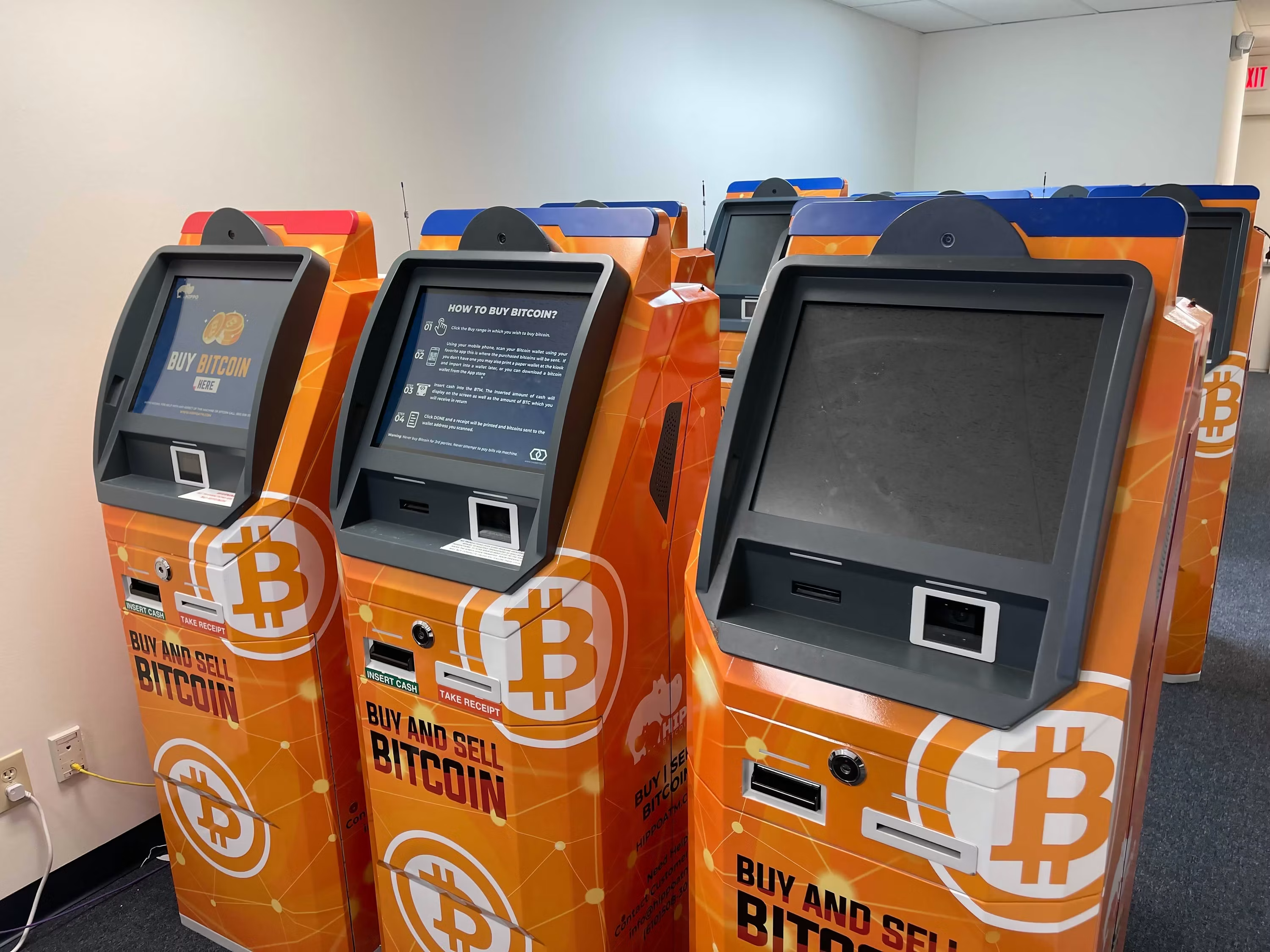
A crypto kiosk is a cash-in machine with a screen and a barcode scanner. You feed it banknotes, it scans a wallet address you provide, and it broadcasts a blockchain transaction. That is genuinely the whole product. It is not connected to your bank, it does not hold an account balance for you, and — this is the part people misunderstand — it is not operated by the store it stands in.
Pennsylvania has several hundred of these machines, plus a much larger network of supermarket coin-counting kiosks that now sell bitcoin as a side product. Coverage is heavily concentrated in Philadelphia and its inner suburbs, with meaningful clusters in the Lehigh Valley, Greater Pittsburgh and the Wyoming Valley, and thin-to-nonexistent coverage across most of the Commonwealth's rural land area.
This guide covers the mechanics, the operators, the identity rules, the real cost, the current legal position, and — at length, because it matters more than anything else here — the fraud problem that has made Pennsylvania one of the harder-hit states in the country.
How a Pennsylvania crypto kiosk actually works
The sequence is consistent across operators, and knowing it in advance removes most of the friction.
- You verify your identity to the operator
Usually a mobile number for the smallest amounts, escalating to a government photo ID scan and a live camera capture. Some operators want you enrolled before you arrive; most let you do it at the machine, which takes several minutes.
- You provide a receiving wallet address
Either by showing a QR code from your own wallet app, or by letting the machine create a custodial wallet for you. Always prefer your own wallet — a custodial address created by a kiosk is an account you now have to manage with a company you just met.
- You insert cash
Notes only, no coins, no cards. Most machines will not give change, so what goes in is what gets converted. Insert the smallest note first so you can read the quoted rate before committing the rest.
- The screen quotes a rate and a total
This is the moment that matters. The quoted exchange rate is worse than the market price, and that difference is a fee that is never labelled as one. If it is worse than you expected, cancel — every compliant machine has a cancel option before confirmation.
- You confirm and the transaction broadcasts
Coins arrive after network confirmation, usually within minutes but occasionally longer during congestion. Once broadcast it is irreversible. Keep the receipt — it carries the operator's support number and the transaction reference.
If a transaction fails, if you send to the wrong address, if the machine takes cash and does not deliver — the host business has no access to the transaction system. This is true whether the machine sits in an independent bodega or inside a well-known chain. Every dispute goes to the operator's support line, printed on the machine and your receipt.
Where Pennsylvania's crypto kiosks actually are
Machines follow cash, not population. That means commercial corridors, convenience stores, gas stations, laundromats, check-cashing storefronts, smoke shops and — increasingly — supermarket concourses. Office districts have surprisingly few.
Southeastern Pennsylvania carries the heaviest density by a wide margin. Philadelphia's Northeast — Roosevelt Boulevard, Cottman, Castor and Frankford Avenues — is the single largest cluster in the state. Upper Darby's 69th Street district is the densest suburban concentration. Chester, Norristown and Reading all carry significant coverage relative to their size.
The Lehigh Valley has an unusually high kiosk-to-population ratio, concentrated on Allentown's 7th Street and Hamilton Street corridors and along MacArthur Road in Whitehall. Greater Pittsburgh is more modest — Penn Avenue through the East End, East Carson Street on the South Side, the Route 51 corridor, and suburban gas stations in Monroeville and Robinson.
Central and northern Pennsylvania thin out quickly. Harrisburg, Lancaster, York and Williamsport each have working networks along their main corridors. Erie has perhaps two dozen machines. Cambria, Lawrence, Blair and the rural counties have a handful or none.
Western Pennsylvania has one piece of genuine history here: in 2019, Altoona-headquartered Sheetz piloted bitcoin ATMs at six stores in partnership with a kiosk operator — Altoona, Pittsburgh, Chambersburg, Harrisburg and State College, plus one location in North Carolina. Customers enrolled with the operator beforehand and transactions ran from $5 to $5,000 per day. It made Sheetz one of the earliest large US convenience chains to put a crypto kiosk on the shop floor.
Operators active in Pennsylvania
Ten networks account for most Pennsylvania coverage. The fee ranges below are indicative — kiosk pricing varies by individual machine, host location and transaction size, and the number that matters is the one the screen quotes you before you confirm.
| Operator | Buy cost (typical) | Sell cost | Two-way? | Daily limit |
|---|---|---|---|---|
| Bitcoin Depot | ~$3 flat + high percentage; commonly ~10–20% all-in | Mostly buy-only machines | Rare | Tiered, up to ~$25,000/day at some locations |
| CoinFlip | Around $3 + ~7–9% depending on machine | Roughly 4–5% | Many machines | Typically $5,000–$25,000 by verification tier |
| Athena Bitcoin | Commonly cited at 10–25% | Around 5% | Some machines | Varies by tier and location |
| Coinme (Coinstar kiosks) | Around 4% transaction fee plus a spread; some locations quote a cash exchange fee near 16.5% | Not supported at Coinstar kiosks | No | Set by Coinme account tier |
| Byte Federal | Typically low-to-mid teens all-in | Available at two-way units | Some machines | Tiered by verification level |
| RockItCoin | Typically low-to-mid teens all-in | Available at two-way units | Some machines | Commonly up to $25,000 with full verification |
| GetCoins | Typically low-to-mid teens all-in | Limited | Few | Tiered |
| Coinsource | Typically around 10–20% all-in | Available at two-way units | Some machines | Original Sheetz pilot ran $5–$5,000 per day |
| Cash2Bitcoin | Varies by machine, generally double digits | Available at two-way units | Some machines | Tiered by verification |
| Independent operators | Frequently above 20% all-in | Rarely supported | Rare | Highly variable |
Compiled from operator disclosures, published fee guides and regulator statements, August 2026. Individual machines vary. Confirm the rate on screen before inserting cash.
Operator notes worth knowing
Runs a three-tier KYC programme: roughly $20–$960 on name, date of birth and mobile number; $960–$2,995 adds a government photo ID and third-party checks; $2,995 and above adds SSN collection and support pre-approval. Now requires ID verification on every transaction across its US network.
One of the more transparent operators on published pricing, and one of the wider two-way networks — useful if you specifically need to sell for cash. Enrolment happens at the machine or in advance through the operator.
The District of Columbia Attorney General has alleged that Athena levied hidden charges of up to 26% per transaction — a reminder that the advertised fee and the all-in cost are different numbers. Read the quoted rate on screen before confirming.
Runs on the existing Coinstar coin-counting footprint, so coverage in Pennsylvania supermarkets is far wider than any standalone crypto kiosk network. You provide a phone number and complete a Coinme account; creating it before you arrive saves time at the machine.
Supports a broader asset range than most kiosk networks, which occasionally matters if you want something other than bitcoin. Coverage in Pennsylvania is respectable but concentrated on the main commercial corridors.
Runs a phone support line staffed during extended hours, which is more useful than it sounds when a transaction stalls mid-way. Also publishes guidance on prepaid card and gift card purchases.
One category deserves its own warning. Independent single-machine operators — typically found in smoke shops, bodegas and small convenience stores — are consistently the most expensive in Pennsylvania and the least likely to display a rate before you commit. If you cannot identify who operates a machine from its screen or its casing, walk away.
ID rules and transaction tiers at Pennsylvania machines
Every legitimate kiosk operator in the United States is a money services business registered with FinCEN, which brings anti-money-laundering obligations under the Bank Secrecy Act. In practice that produces a tiered verification structure. The tiers below reflect a common pattern; exact thresholds vary by operator.
| Tier | Typical amount | What you provide | Notes |
|---|---|---|---|
| Tier 1 | ~$20 – $960 | Name, date of birth, mobile phone number | Where most first-time users start. Verified by SMS code. |
| Tier 2 | ~$960 – $2,995 | Government photo ID scan plus a live selfie matched to it | Covers most casual purchases. Automated third-party identity checks run in the background. |
| Tier 3 | ~$2,995 – $19,000+ | Social Security number and enhanced screening | Often requires pre-approval through the operator's support team before the machine will proceed. |
Two points that surprise people. First, several major operators have moved to requiring ID verification on every transaction regardless of size — Bitcoin Depot announced a mandatory ID check across its US network. Second, no Pennsylvania statute currently caps kiosk transaction amounts; the limits you encounter are operator policy, not state law.
A machine that offers unlimited anonymous purchases is not operating within federal MSB rules. That is a reason to leave, not a feature to seek out.
What Pennsylvania kiosks really cost
Kiosk pricing has two layers and operators advertise only one. The visible layer is the transaction fee — a percentage, often with a flat dollar amount attached. The invisible layer is the exchange rate the machine uses, which is deliberately worse than the market price. Add both and you get the number that matters.
Across Pennsylvania, that all-in figure typically lands between 8% and 23%. Large national networks tend toward the lower half; independent single-machine operators regularly exceed 20%. The cheapest kiosk transactions we have found in the Commonwealth still ran around 11% once the spread was counted.
Put in dollars: a $500 cash purchase at 15% leaves you with about $425 of bitcoin. The same $500 through an ACH-funded order on a licensed exchange leaves you with about $496. Repeated monthly, that gap is over $850 a year.
Our Pennsylvania crypto ATM fee comparison works through the operator-by-operator numbers, the flat-fee effect on small purchases, and how to read a machine's quote before you commit.
The same bitcoin, roughly one twentieth of the fee
An ACH-funded order on a platform holding Pennsylvania Money Transmitter Licence 112703 and FinCEN MSB registration typically costs under 1% all-in. Verification takes under ten minutes with a PennDOT ID.
The law: licensing and what is moving through Harrisburg
Pennsylvania's position on cryptocurrency reversed once, and the reversal matters.
In January 2019 the Department of Banking and Securities issued guidance stating that virtual currency is not "money" under the Pennsylvania Money Transmission Business Licensing Law — meaning the operator of a virtual currency exchange platform, kiosk, ATM or vending machine did not require Pennsylvania licensure. On 20 April 2024 the Department issued a policy statement clarifying that its interpretation of "money" under the Act does include virtual currency such as Bitcoin, effective 15 October 2024. From that date, persons transmitting virtual currency for a fee are expected to obtain a licence.
Federal obligations run in parallel: FinCEN requires administrators and exchangers of convertible virtual currency to register as money services businesses under the Bank Secrecy Act.
Senate Bill 1015 — the Virtual Currency Kiosk Regulation Act
Introduced in September 2025 and given a committee hearing in April 2026, SB 1015 would put kiosk-specific consumer protection rules on the statute book for the first time. As proposed, operators would be licensed by the Department of Banking and Securities and required to comply with:
- Daily transaction limits set in statute rather than by operator policy
- Caps on transaction fees
- Identity verification requirements
- Pre-transaction disclosures covering the material risks of cryptocurrency and a plain-language fraud warning
- Written anti-fraud policies, including a specific policy protecting elderly and vulnerable adults from financial exploitation
- Blockchain analytics obligations
- Live 24-hour customer service
- Detailed receipts for every transaction
- Quarterly kiosk location reporting to the Department
Companion legislation has been circulated on the House side. The direction of travel is clearly regulation rather than prohibition — nothing currently before the General Assembly would ban kiosks or restrict individual ownership of digital assets. Our Pennsylvania crypto law guide tracks the detail.
Fraud: the section we would ask you to read even if you skip the rest
Crypto kiosks have become the preferred settlement channel for phone-based fraud in the United States, and Pennsylvania is one of the harder-hit states.
Pennsylvania ranked sixth nationally for internet crime complaints in the FBI's 2025 Internet Crime Report, with more than 31,000 complaints and over $537 million in reported losses. Nationally, crypto-kiosk fraud complaints to IC3 reached 13,460 in 2025 with $389 million in reported losses — a 58% increase in losses year over year. Older Americans accounted for the majority of those dollars. Pennsylvania's Bureau of Consumer Protection reported that 85% of the crypto fraud complaints it received came from people aged 60 or over.
The mechanics never vary. A caller impersonates a utility, a government agency, a court, a bank's fraud department or a family member in trouble. They manufacture urgency. They stay on the line — that is essential, because the fraud only works while the victim is isolated. They direct the victim to a specific kiosk they have looked up on a public map, and coach them through scanning a QR code. That QR code is the scammer's wallet. Once the transaction confirms, it is gone.
No legitimate organisation will ever ask you to pay at a cryptocurrency machine. Not PECO, PPL, Duquesne Light, Penelec or Met-Ed. Not the IRS or the Social Security Administration. Not any Pennsylvania court, sheriff's office or police department. Not any immigration authority. Not your bank. Not a grandchild in custody. If anyone on a phone is directing you to a machine, hang up and call the organisation back on a number you looked up yourself.
Three operational rules follow: never transact at a kiosk while on a phone call, never scan a QR code somebody else provided, and treat urgency as automatic evidence of fraud. If a loss has already happened, act immediately — call the operator support number on the machine or receipt, report to local police, and file with the Pennsylvania Attorney General and IC3. Keep the receipt, the wallet address and the caller's number.
Our Pennsylvania crypto scam guide lists the specific scripts currently circulating in the Commonwealth, by region.
Cheaper alternatives, honestly assessed
There is a real use case for kiosks: instant conversion, cash accepted, no bank account required. If that describes your situation, they are a legitimate tool and this guide is not here to shame you for using one. But most Pennsylvania kiosk users do have alternatives, so here they are in ascending order of cost.
- A bank or credit union account plus a licensed exchange
Under 1% all-in. Pennsylvania has an unusually strong credit union sector, and many institutions offer accounts with $5–$25 minimums, including second-chance products for people with past overdraft history. This is the answer for the large majority of readers.
- A debit card purchase on a licensed exchange
Roughly 2–4%, instant. Sensible when you want coins today and the amount is modest.
- Retail cash-to-crypto at a supermarket
Coin-counting kiosks that now sell bitcoin, and prepaid networks that let you load cash at a retail counter. Typically mid single digits — worse than a bank transfer, better than a standalone crypto ATM. See our cash buying guide.
- A crypto kiosk
8–23% all-in. Fast, cash-friendly, no bank needed, and the most expensive route available.
Bitcoin ATMs by Pennsylvania city
Coverage, pricing pressure and fraud patterns all vary locally. These guides cover where machines cluster in each city and what to expect from them.
Philadelphia
Philadelphia County
Roosevelt Blvd, Cottman Ave, Castor Ave and Frankford Ave — the densest cluster in the city, mostly gas stations and 24-hour convenience stores.
Local ATM guide →Pittsburgh
Allegheny County
Penn Avenue and Baum Boulevard corridor — the densest East End cluster, mostly convenience stores.
Local ATM guide →Allentown
Lehigh County
The densest downtown cluster, inside bodegas, convenience stores and money-service storefronts.
Local ATM guide →Reading
Berks County
The main downtown cluster, generally inside stores that also offer check cashing and money transfer.
Local ATM guide →Erie
Erie County
The main commercial artery — gas stations and convenience stores from 12th Street south toward Millcreek Mall.
Local ATM guide →Scranton
Lackawanna County
A small central cluster in convenience stores near the courthouse square and transit centre.
Local ATM guide →Harrisburg
Dauphin County
The densest in-city cluster, in neighbourhood convenience stores.
Local ATM guide →Upper Darby
Delaware County
Pennsylvania's densest suburban kiosk cluster, around the terminal and along Market Street.
Local ATM guide →Wilkes-Barre
Luzerne County
The county's densest cluster, around the Wyoming Valley Mall and Highland Park big-box strip.
Local ATM guide →Browse all 28 Pennsylvania city guides → · Browse by county →
Pennsylvania bitcoin ATM FAQ
How many bitcoin ATMs are there in Pennsylvania?
Several hundred across the Commonwealth, with the heaviest concentrations in Philadelphia and its inner suburbs, the Lehigh Valley and Greater Pittsburgh. Counts move constantly as operators rotate host contracts, and separately, retail networks like Coinme running on Coinstar kiosks add many hundreds more supermarket locations that sell bitcoin without being standalone crypto machines.
Do Pennsylvania bitcoin ATMs require ID?
Almost always. Operators run tiered verification: the smallest transactions may need only a mobile phone number, mid-range purchases require a government photo ID scan plus a live selfie, and larger amounts trigger Social Security number collection and sometimes manual pre-approval. Bitcoin Depot now requires ID verification on every transaction across its US network. A machine offering unlimited anonymous purchases is not operating within federal MSB rules.
What is the maximum I can buy at a crypto ATM in Pennsylvania?
Limits are set by the operator and your verification tier, not by Pennsylvania law — there is currently no statutory cap. Typical structures run from a few hundred dollars on phone-only verification, through several thousand with a full ID scan, up to $19,000–$25,000 per day with SSN verification and manual approval. Sell limits are usually lower than buy limits.
Are crypto ATMs legal in Pennsylvania?
Yes. Since 15 October 2024, the Department of Banking and Securities expects businesses transmitting virtual currency for a fee to hold a Pennsylvania Money Transmitter Licence, and federal law requires FinCEN MSB registration. Senate Bill 1015 would add kiosk-specific rules — daily limits, fee caps, mandatory warnings, live 24-hour support — but has not been enacted.
Can I sell bitcoin for cash at a Pennsylvania ATM?
Only at two-way machines, which are a minority of the installed base. They also carry lower daily caps than buy limits and frequently run out of banknotes. Call the host business before travelling. For anything beyond a few hundred dollars, selling on an exchange and withdrawing by ACH is faster and far cheaper — see our selling guide.
Why are crypto ATM fees so high?
Because the machines are not competing on price. Nobody comparison-shops a kiosk they happened to walk past, and most machines do not display the exchange rate until after you have committed cash. Operators also carry real costs — cash logistics, compliance programmes, host rent, machine hardware — but those do not explain a 20% spread. The premium is for convenience and cash acceptance.
What happens if a bitcoin ATM takes my cash and does not deliver?
Contact the operator's support number, printed on the machine and on your receipt. The host store cannot help — staff have no access to the transaction system, regardless of whose brand is on the building. Keep the receipt. If the operator does not resolve it, file a complaint with the Pennsylvania Attorney General and the Department of Banking and Securities.
Are crypto ATM transactions reversible?
No. Once a blockchain transaction confirms, it cannot be undone by the operator, the police, the host store or anyone else. This is why kiosk-directed fraud is so damaging and why you should never scan a QR code someone else provided.
A licensed alternative to the machine on the cornerPA Money Transmitter Licence 112703 · FinCEN-registered MSB · NMLS ID 1804170 · bank funding at a fraction of kiosk cost.
Get started